- English
- French
- German
- Portuguese
- Spanish
- Russian
- Japanese
- Korean
- Arabic
- Greek
- German
- Turkish
- Italian
- Danish
- Romanian
- Indonesian
- Czech
- Afrikaans
- Swedish
- Polish
- Basque
- Catalan
- Esperanto
- Hindi
- Lao
- Albanian
- Amharic
- Armenian
- Azerbaijani
- Belarusian
- Bengali
- Bosnian
- Bulgarian
- Cebuano
- Chichewa
- Corsican
- Croatian
- Dutch
- Estonian
- Filipino
- Finnish
- Frisian
- Galician
- Georgian
- Gujarati
- Haitian
- Hausa
- Hawaiian
- Hebrew
- Hmong
- Hungarian
- Icelandic
- Igbo
- Javanese
- Kannada
- Kazakh
- Khmer
- Kurdish
- Kyrgyz
- Latin
- Latvian
- Lithuanian
- Luxembou..
- Macedonian
- Malagasy
- Malay
- Malayalam
- Maltese
- Maori
- Marathi
- Mongolian
- Burmese
- Nepali
- Norwegian
- Pashto
- Persian
- Punjabi
- Serbian
- Sesotho
- Sinhala
- Slovak
- Slovenian
- Somali
- Samoan
- Scots Gaelic
- Shona
- Sindhi
- Sundanese
- Swahili
- Tajik
- Tamil
- Telugu
- Thai
- Ukrainian
- Urdu
- Uzbek
- Vietnamese
- Welsh
- Xhosa
- Yiddish
- Yoruba
- Zulu
Is seamless or welded pipe better?
Many procurement managers want to know if seamless or welded pipes are preferable for base construction and infrastructure projects. The answer relies on project goals, funding, and plan details. Steel pipe welding methods, including ERW, SSAW, and LSAW, have improved. Large-scale construction projects, piling systems, and energy infrastructure may now obtain them more cheaply and more strongly with greater structural freedom. New welding technology and strong quality standards make welded steel pipe solutions as effective as seamless pipes in many challenging conditions. This makes them the greatest choice for projects that need to balance performance with sourcing economy.
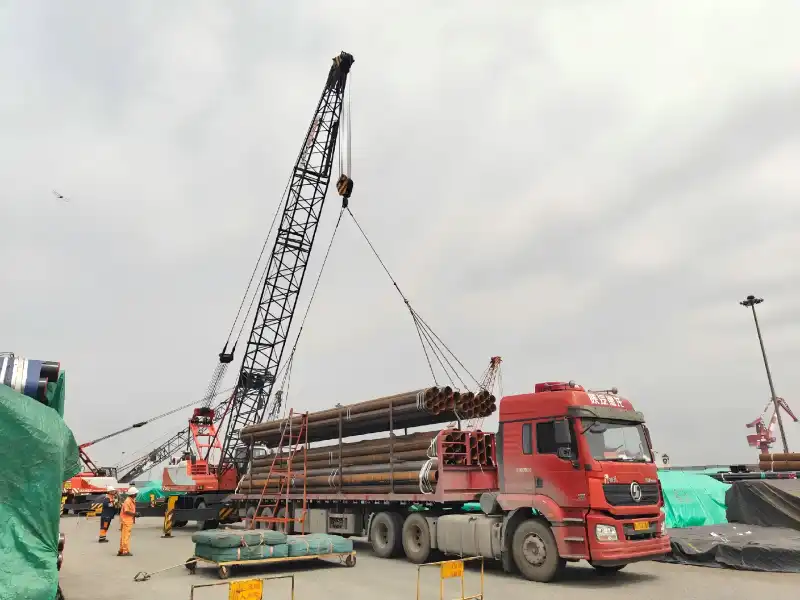
Understanding Seamless and Welded Steel Pipes
How steel pipes are produced affects their performance and durability. Melted steel billets are forced through dies to form seamless pipes. Cylindrical pipes without longitudinal joints. For uses exceeding 10,000 psi, seamless pipes are utilized since they are one piece and don't have weak points like weld joints.
Welded pipes employ flat steel plates or strips. They are then cylinders and linked in a straight or circular. Business welding has three primary types:
ERW (Electric Resistance Welded) Process
ERW melting uses high-frequency electrical resistance to melt steel strip ends. After that, molecules are pressured to connect. This process produces pipes from 21.3 mm to 660 mm in diameter. Smooth insides and regular widths characterize these pipes. ERW carefully controls tolerances, making it ideal for building structures, water transfer systems, and low-pressure applications that need regularity.
SSAW (Spiral Submerged Arc Welded) Process
The SSAW technique wraps steel coils at specific angles and welds the spiral junction using submerged arc methods to create a helix seam. It's straightforward and affordable to construct pipes with wall thicknesses that can handle pressures and diameters from 219 mm to 3,500 mm with this approach. Spirals distribute stress better than straight lines when loads are dispersed. Long-distance pipeline and marine piling projects that need corrosion protection and minimal material utilization benefit from this.
LSAW (Longitudinal Submerged Arc Welded) Process
Making LSAW pipes involves pressing or rolling steel plates into cylinders. Submerged arc welding from inside and outside joins the straight seam. This double-sided welding strengthens heavy-wall pipes up to 7,000 mm long and 230 mm thick. High-pressure power lines, platforms at sea, bridge supports, and deep pile systems that carry huge loads benefit from these methods.
Knowing these pipe manufacturing variations helps project managers and engineering leaders choose pipes for foundation and infrastructure projects' weather, load demands, and installation.
Technical Comparison: Seamless vs. Welded Steel Pipes
How effectively seamless and bonded designs function depends on product demands, quality control, and technological aspects. Seamless pipes feature uniform grain and no join zone issues. Since their creation, better metals and tighter inspection have improved welded pipe performance.
Mechanical Strength and Stress Tolerance
Some pipes are constructed of a consistent substance throughout. It may stretch above 760 MPa for high-strength metals and 415 MPa for basic grades. No longitudinal joints mean it's not weak anywhere. Stress can't be bidirectional. Smooth setups are ideal for large pressure or fatigue loading changes.
However, the new API 5L PSL2 welded steel pipe has the same mechanical performance due to chemical and heating management. The lowest yield strengths for PSL2 grades X52M–X80M are 359–555 MPa. Charpy V-notch tests demonstrate they're harder. A heat-affected zone (HAZ) study on the weld zone ensures metal compatibility and prevents weak failure mechanisms.
Quality Control and Inspection Standards
Throughout production, stringent testing ensures welded pipes are sturdy. To ensure real-world functionality and leak resistance, API 5L requires hydraulic testing at 1.5 times the design limit. Here are some non-destructive testing methods:
- Ultrasonic Testing (UT): Cracks, laminations, and partial fusion can be detected by sound waves flowing along weld lines. You can notice 3 mm faults.
- Radiographic Examination (RT): X-rays are used to examine for weld penetration, holes, slag areas, and fusion difficulties.
- Eddy Current Testing: Surface and near-surface crack detection ensures that the coating stays immaculate on the outside of the item.
- Dimensional Verification: Laser scanning and touch measures ensure ISO 3183 compliance for outside width, wall thickness, and ovality limitations.
These inspection procedures have a statistically high possibility of discovering defects, keeping buildings stable for energy transmission, foundation piling, and bridge substructures.
Corrosion Resistance Considerations
Smooth or soldered lines might corrode depending on the material and climate. Due to microstructure changes and residual tension, welded joints didn't rust before. Modern post-weld heat treatment (PWHT) reduces these pressures and evens the HAZ microstructure. This reduces pipe body corrosion.
When applied appropriately, fusion-bonded epoxy (FBE), three-layer polyethylene (3LPE), and hot-dip galvanizing protect soldered and seamless lines from rust. Marine piling, wastewater infrastructure, and rocky soil projects should use a layer with the proper pH, chloride, and cathodic protection.
Application Suitability: When to Choose Seamless or Welded Pipes?
The optimal pipe relies on the project's demands, use, and cost. Knowing where each pipe type works best helps procurement managers choose designs that satisfy price and function.
High-Pressure and Critical Applications
Smooth pipes are excellent when the pressure inside is over 2,500 psi; otherwise, failure might harm people or the environment. Because it has no horizontal lines to distribute fractures under cycle loads, its attributes are consistent. It can create chemical reactor pipes, oil and gas well casing, and hydraulic cylinders.
Infrastructure and Foundation Engineering
For constructing structures, welded steel pipes are cheaper and available in more diameters than seamless ones. For projects using 273–2,500 mm pipe piles, designs must be welded to API 5L Grade B–X70 specifications. Being able to manufacture 100-meter sections reduces field joints. This accelerates sheet piling and ditch support system construction and reduces leakage.
LSAW pipe may be cut to specific diameters to fit pipe-holding capacity and ground conditions for bridge foundation construction. In soft soil areas that necessitate deep foundations, welded pipe piles with large walls are optimum for driving resistance and load transfer.
Water Transmission and Municipal Systems
Welded pipe is excellent for water supply networks, stormwater management systems, and wastewater collecting structures beyond 400 mm. SSAW efficiency for trunk mains and ERW accuracy for smaller distribution lines save money over project life. Using less material and improving procedures reduces expenses. The correct interior coatings make them potable and water-safe according to AWWA C200 and NSF/ANSI 61.
Energy and Industrial Projects
Power stations, industrial structures, and offshore platforms utilize seamless and welded kinds according to service circumstances. For high-temperature steam lines above 450°C, seamless pipe is usually better because it prevents weld zone movement. Strength and ease of joining make API 5L PSL2 width-weld pipe and API 5L X52 welded steel pipe preferable for supports, jacket legs, and conductor pipes.
You can produce unique parts for severe industrial structures with LSAW and SSAW since you can deal with varied metal diameters. This helps with field welding and quality control issues. Fast-building projects benefit from pre-made welded pipe parts with finishes and test certificates.
Procurement Insights: Factors Affecting Purchase Decisions
Strategic buying requires consideration of technology, commercial terms, and supply chain stability. Buying managers may maximize project budgets without sacrificing quality if they understand why seamless pipe costs more and what welded pipe dealers can do.
Cost Analysis and Budget Considerations
Seamless steel pipes of the same size and quality often cost 30% to 60% more than welded steel pipe. This is because they're easy to manufacture and utilize more. ERW can transform steel coils into pipes 98% of the time and wastes nothing. Material is best used with SSAW and LSAW, which match plate thicknesses to end dimensions. Instead of smooth billet cutting, this reduces waste.
Since seamless up to 660 mm wide requires specific techniques, price gaps increase with width. While satisfying API 5L PSL2 technical requirements, welded LSAW alternatives save money for 1,000 mm diameter deep base pipes.
Supplier Qualification and Certification
Certified vendors with high-quality control are safer to buy from. ISO 9001:2015 and the API 5L monogram license demonstrate structured manufacturing. Certifications demonstrate that the plant has been evaluated and tested to satisfy requirements. Suppliers with ASME Section II material certifications and AWS D1. 1. Welding expertise can be trusted more in building code projects.
Case studies of projects they've worked on in similar regions, with similar project numbers and performance requirements, are another approach to assess a supplier's technical competence beyond paper certifications. Suppliers that have worked on complex foundation engineering projects understand how pipe specifications, movement dynamics, and the structure's long-term behavior under mixed pressure interact.
Lead Times and Order Flexibility
Stock from well-known welded pipe manufacturers ships in 4–6 weeks, speeding up projects. Special grades, sizes, or testing techniques might take 10–16 weeks. This depends on mill hours and raw material availability.
When the market is tight, solid seller connections assist procurement teams in securing good allocation and payment conditions for significant contracts. Vendor-managed inventory systems or regional warehouses make moving items easier for multi-stage projects spanning several building seasons.
Making the Right Choice: Seamless or Welded Pipe?
Choosing the best pipes requires considering technical demands, project restrictions, and pipe longevity. This technique should assist buying teams in choosing:
- Application Assessment: Select the highest operating pressure, temperature range, corrosion environment, and stress levels. Sheathed versions save money and work well below 2,000 psi and at mild temperatures. High-pressure or fatigue-stress circumstances benefit from seamless standards.
- Dimensional Requirements: Wider than 660 mm requires welded steel pipes. LSAW provides the highest structural wall thickness control. ERW is suitable for making pipes under 200 mm wide.
- Budget Constraints: API 5L PSL2 welding lines are cheaper for low-cost projects. If something goes wrong, customers may use their savings to acquire new seals or improve their current ones.
- Supplier Capability: Ask the maker about project experience. Check mill test findings to check whether specs match and make sure project inspection matches quality plans.
- Regulatory Compliance: Choose pipe sizes and procedures that meet construction requirements, environmental legislation, and client needs. The API 5L, ASTM A252, and EN 10219 standards are popular for welding construction pipe.
According to emerging green construction trends, welded steel pipe (such as API 5L X52 welded steel pipe) utilizes less material and has a lower carbon footprint per ton of completed product. Industry energy usage and recycling rates are being utilized in life cycle studies to guide purchases. In certain areas, welding pipes is beneficial.
Conclusion
It's less essential to make general assertions regarding seamless vs. welded steel pipe. It's more crucial that production features match application demands. If manufactured to rigorous API 5L specifications, modern welded pipe technology, like ERW accuracy, SSAW efficiency, and LSAW heavy-wall capability, performs well in base building, energy, and infrastructure projects. If the project demands efficiency and cost-effectiveness, welded setups are appropriate. Cheap, customizable up to 7,000 mm in diameter, and with proven quality control systems. Project demands, pressure levels, corrosion conditions, and source expertise must be considered while choosing pipes. This lets engineers and procurement managers choose the most durable construction options.
FAQ
1. Which type of pipe offers better strength for foundation piling?
Welded steel pipe is preferable for basic applications, even if seamless pipes are stronger than welded pipes according to API 5L PSL2 requirements. X52M to X70M PSL2 grades have yield strengths between 359 MPa and 555 MPa, and Charpy impact tests demonstrate they are stronger than others. To ensure compatibility with the base material, the weld zone undergoes a heat treatment and acoustic test. Welded pipe designs for deep foundations, naval buildings, and bridge substructures meet these demanding specifications.
2. Can welded pipes handle high-pressure applications?
If the pipe is well-made and of the proper type, it can handle high pressure. This applies even with a weld line. If correctly manufactured and hydrostatically verified, API 5L PSL2 operates well in transmission tubes at pressures exceeding 1,500 psi. Welded designs work for most foundation digging, water transfer, and construction operations under 2,000 psi. Smooth specifications may be needed for high pressure exceeding 3,000 psi or many wear cycles. This relies on government safety and claims.
3. What quality testing ensures welded pipe reliability?
To ensure stability, welded steel pipe is verified throughout manufacture. The weld lines must be tested with ultrasonic waves for faults larger than 3 mm, the measurements checked for wall thickness and breadth, and the mechanical qualities tested with tensile and impact tests. Mill test records must include chemicals, metal heating, and non-destructive test results for API 5L compliance. These reports ensure project documents are readable and of high quality.
Partner with HYPILE for Superior Welded Steel Pipe Solutions
With over 45 years of production and project execution experience, HYPILE can provide piling and foundation services. We have a large selection of API 5L PSL1 and PSL2 ERW, SSAW, and LSAW welded steel pipe. Our kinds include Gr.B and high-strength X80M. We can create pipes up to 7,000 mm wide, 230 mm thick, and 100 m long. We can assist with complex base projects in infrastructure, military buildings, and urban development. Our "BUILD TO THE LAST" attitude ensures unrivaled quality through rigorous inspections and cutting-edge finishing techniques. Discuss your project demands with our technical staff at sales@hypile.com to see how our welded steel pipe vendor can provide dependable, cost-effective solutions with complete engineering assistance and international certifications.
References
1. American Petroleum Institute. (2018). Specification for Line Pipe: API 5L Forty-Sixth Edition. Washington, DC: API Publishing Services.
2. Bai, Y., & Bai, Q. (2014). Subsea Pipeline Design, Analysis, and Installation. Oxford: Gulf Professional Publishing.
3. Gresnigt, A. M., & Karamanos, S. A. (2009). Local Buckling Strength and Deformation Capacity of Pipes. Proceedings of the International Offshore and Polar Engineering Conference, 212-219.
4. Macdonald, K. A., & Cosham, A. (2005). Best Practice for the Assessment of Defects in Pipelines – Gouges and Dents. Engineering Failure Analysis, 12(5), 720-745.
5. Rothwell, A. B. (1992). Welded Steel Pipes: Design and Installation Practices for Water Transmission. Denver: American Water Works Association.
6. Zhang, Y., & Liu, X. (2016). Manufacturing Technology and Quality Control of Large Diameter LSAW Steel Pipe. Journal of Materials Processing Technology, 238, 168-175.
Have a project in mind? Tell us your goals — we’ll help you make it real.